
The Second Generation: From Retail to Wholesale

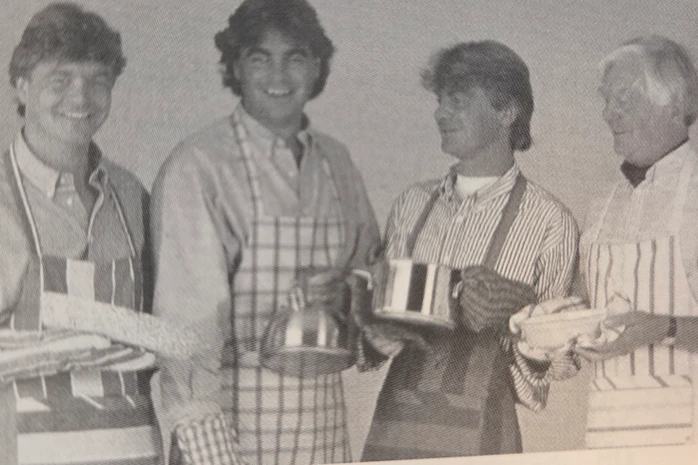
Following Frans Wegter’s start in Delden, a new phase began in the company’s history—a phase in which the foundation was laid for the growth that would follow. That role fell to Nico Wegter, the son of Frans (the first, grandfather) and the father of Marc.
He took over the business at a young age. At a time when business was still primarily local, he saw opportunities to look beyond the immediate area. While the first generation laid the foundation with a store and the earliest forms of trade, Nico Wegter expanded this into a major wholesale business.
From Retail to Wholesale
In 1960, the store in Delden was sold. This was a major decision, as it shifted the company’s entire focus to the import of glass, porcelain, and pottery. It was a choice that required vision. The company let go of the security provided by the store to make room for growth.
That growth soon began to take shape, mainly because the company was increasingly focusing on larger customers, such as Albert Heijn, Makro, and Wehkamp. In 1964, Nico Wegter had a new building constructed on Vossenbrinkweg in Delden. From there, the company began supplying stores across an ever-wider area. The company evolved from a local player into an organization with a broader reach.
Entrepreneurship means looking ahead
The years that followed were marked by expansion and development. Business is growing, the product range is expanding, and the company is gaining more and more customers. But it’s not just about growth in size. Above all, it’s the company’s approach to business that makes the difference. Nico understands that standing still is not an option. At a time when many companies are sticking close to home, he’s looking further afield. He’s willing to invest, take risks, and seize opportunities that others might overlook.
In the mid-1970s, the company responded to a new trend in the market. Foodservice wholesalers, which until then had focused primarily on food products, began expanding their product lines to include non-food items. Wegter recognized this shift and adapted to it, thereby adding a new customer base and enabling the company to continue growing within a expanding market.
At the same time, sourcing products from outside the Netherlands is also becoming increasingly important. While earlier generations had already begun to cautiously look beyond the border, this trend is expanding further during this period. It lays the foundation for international trade, which will later play an important role.
Adapting to change
The market is changing rapidly during this period. New players, different procurement methods, and economies of scale are creating a dynamic environment in which flexibility is essential. Nico responds to this by continually adapting and further developing the company—not with grand statements, but by doing what needs to be done. Practical, down-to-earth, and with an eye toward the long term. These are choices that may not always be immediately apparent, but which prove decisive for the direction of the company.
The quiet force behind the next step
What characterizes Nico’s tenure is that the company was truly established during those years. The foundation was strengthened, the direction was set, and opportunities for further growth were created.
When the next generation takes over later on, there will be a foundation upon which to build. A foundation built on entrepreneurship, perseverance, and the ability to look ahead.
The transition from Frans to Nico Wegter thus marks more than just a generational shift. It is the moment when the foundation was laid for the company as we know it today.